
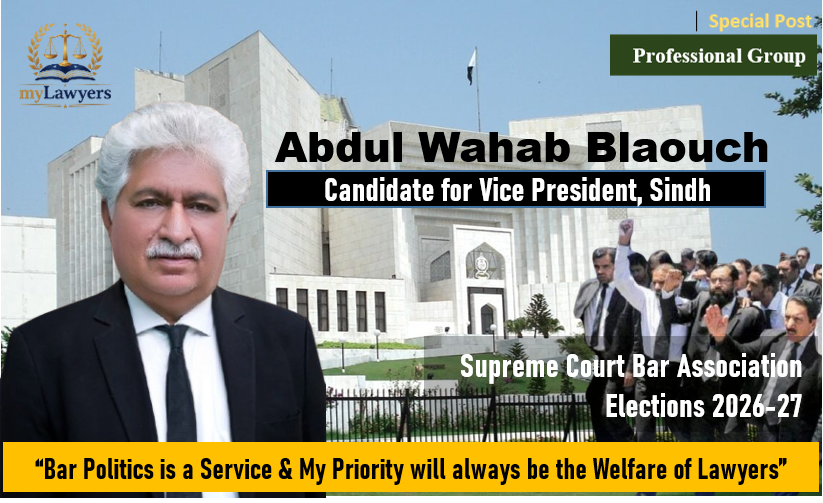
Having more than 32 years of legal practice behind him, senior advocate Abdul Wahab Blaouch needs little introduction in Pakistan’s legal fraternity. Regarded as one of the country’s highly respected lawyers and a veteran human rights activist, his professional career is marked by numerous victories in important and rights-based cases. For him, bar politics is not about personal ambition but a form of public and professional service. He believes that advocacy is a “noble profession” and that lawyers must play their role in protecting the independence of the judiciary, democratic values and the rule of law.
Abdul Wahab Blaouch, An Experienced Contestant:
Abdul Wahab Blaouch heads his own firm, Abdul Wahab Blaouch Law Associates, in Karachi. His legal career spans more than three decades, including 17 years of practice as an advocate of the Supreme Court of Pakistan. He has served as a Member of the Executive Committee of the Supreme Court Bar Association from 2012 to 2014 and later as Chairman of the Executive Committee of the Sindh Bar Council in 2015. In 2026, he is contesting the Supreme Court Bar Association elections as the Professional Group’s candidate for Vice President from the Sindh Chapter.
In an exclusive conversation with mylawyers.pk, Abdul Wahab Blaouch discusses his political affiliation, the role of the Professional Group, lawyers’ enrollment, welfare issues and his priorities if elected.
Interview of Abdul Wahab Blaouch:
Question 1: Blaouch sahib, what motivates you to remain a consistent member and election candidate of the Professional Group of Lawyers in your long career?
Abdul Wahab Blaouch: The Professional Group has consistently worked for the independence of the judiciary and the dignity of lawyers and the judicial institution. Historically, it has stood against anti-democratic and anti-constitutional forces. The Lawyers’ Movement of 2007 is a major example. The Professional Group played a leading role in that struggle and remained at the forefront of the movement against dictatorship. The sacrifices made by its leaders and workers are well known. In my view, the Lawyers’ Movement achieved its historic success because of the principled and courageous role played by the Professional Group under the leadership of Hamid Ali Khan.
My association with the group is based on these principles. We believe that the bar should remain independent and should not become an instrument of any government or establishment. We are not covert operators or political proxies of the government or establishment. Unfortunately, I believe our rival group has, on several occasions, demonstrated a tendency to align itself with those in power.
The use of the legacy of the late Asma Jahangir in bar politics is another matter that deserves discussion. Asma Jahangir was a great human rights leader, and her principles were based on democracy, constitutionalism, human rights and independence of institutions. In my opinion, there is a significant difference between invoking her name and genuinely following the principles for which she stood. Their support for the 26th and 27th Constitutional Amendments is one example that illustrates this difference. There should be consistency between political statements and practical actions.
Question 2: You have recently criticized your rival group over the issue of lawyers’ enrollment. What is the background to this controversy?
Abdul Wahab Blaouch: Enrollment in the superior courts is a legitimate professional right of lawyers who fulfill the prescribed requirements, including the required period of practice in the lower courts. My concern is that this legitimate process has been unnecessarily complicated and, in my view, scandalized. There should be transparency, merit and uniformity in the enrollment process. No lawyer should feel that personal connections, political affiliations or favoritism are necessary to secure a professional right.
The issue is not against any individual lawyer. It is about protecting the integrity of the profession. Lawyers who fulfill the legal and professional requirements should be treated fairly and given an equal opportunity.

Question 3: Lawyers are facing financial, social and professional difficulties. What would be your major priorities if elected?
Abdul Wahab Blaouch: My first and foremost priority will always be the welfare of lawyers. The legal profession is a noble profession, but many lawyers, particularly young and financially vulnerable lawyers, face serious difficulties in their professional and personal lives. We need to create a system in which lawyers can practice with dignity.
One of my priorities will be to work for discounts and concessions for lawyers in air travel, other forms of transportation and toll taxes. I also want to improve healthcare facilities for the legal community. During my tenure as a member of the Executive Committee, I worked for establishing space for medical facilities for lawyers, where a doctor regularly provided services. I would like to revive and expand such initiatives. Lawyers should not only have professional representation; they should also have meaningful welfare mechanisms that support them and their families.
Question 4: You have previously worked on facilities at the Supreme Court Bar. What would you do regarding the Bar’s library and other professional resources?
Abdul Wahab Blaouch: The library of the Supreme Court Bar Association is particularly important because lawyers depend on access to legal literature, judgments, legislation and research material. I was involved in establishing the library, but unfortunately, I believe it is not currently functioning at the standard it should. If elected, I would work to make the library functional and modern.
My objective would not simply be to restore the physical library. I would also like to digitize it, so lawyers can have easier access to legal research material, judgments and other important resources. The legal profession is changing rapidly. Modern lawyers need modern research facilities. A strong and digitally accessible library can significantly improve the quality of legal practice.
Question 5: What are your plans for the education and welfare of lawyers’ families?
Abdul Wahab Blaouch: Lawyers’ welfare cannot be limited to the courtroom or the bar room. The families of lawyers are also an essential part of the legal community. Education for lawyers’ children is one of my priorities. We should explore arrangements through which children of lawyers can receive quality education at affordable rates, including scholarships, institutional partnerships and other forms of assistance.
Similarly, healthcare should be developed as a continuing welfare programme rather than an occasional initiative. I believe that a lawyer who spends his or her life serving the justice system should have access to basic social protections and opportunities for the family. These are not luxuries; they contribute to the dignity and security of the profession.
A genuine and transparent housing scheme for lawyers is one of my major priorities. Many members of the legal community, particularly young and middle-income lawyers, struggle to arrange suitable housing. A housing project should therefore be designed on realistic and affordable terms. I would seek to work with the relevant institutions to develop a genuine housing scheme for the legal community, based on transparency, merit and affordability.
Question 6: Finally, what is your broader vision for the legal community if you are elected Vice President of the Supreme Court Bar Association from Sindh?
Abdul Wahab Blaouch: My broader vision is based on three principles: independence of the judiciary, dignity of lawyers and welfare of the legal community. I have spent more than three decades in this profession, and I consider bar politics a form of service rather than a means of personal advancement. The bar must remain independent, democratic and capable of speaking for the rights of lawyers and the constitutional order.
I have always considered myself an activist for human rights, and that philosophy also guides my approach to bar politics. Lawyers from every economic and social background deserve dignity and equal opportunities. A lawyer from a lower-income background should not be deprived of professional opportunities or basic welfare facilities simply because of his or her financial circumstances.
Question 7: And, your final word?
Abdul Wahab Blaouch: The strength of the legal profession depends on the independence and dignity of its members. My objective is to contribute to that strength and ensure that the bar continues to play its constitutional role with courage, integrity and independence.
By
Editorial, mylawyers.pk