
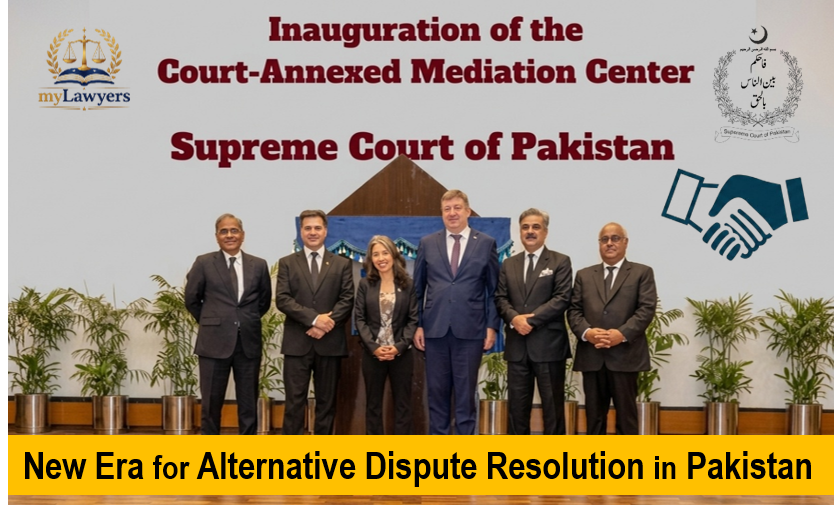
The inauguration of the Supreme Court of Pakistan’s first Court-Annexed Mediation Centre marks an important milestone in the country’s efforts to make justice more accessible, affordable and efficient. Established in collaboration with the European Union and the United Nations Development Programme (UNDP), the centre represents a significant institutional step towards strengthening Alternative Dispute Resolution (ADR) within Pakistan’s justice system.
Court-Annexed Mediation Centre:
For decades, Pakistan’s courts have faced the challenge of mounting litigation, prolonged proceedings and increasing pressure on judicial resources. While litigation remains essential for disputes requiring authoritative adjudication, not every conflict needs to end with a lengthy court battle. This is where ADR—particularly mediation—can play a transformative role. The new Court-Annexed Mediation Centre can therefore become an important mechanism for reducing avoidable litigation and court congestion.
Mediation provides disputing parties with an opportunity to resolve their differences through dialogue and negotiation with the assistance of a neutral mediator. Unlike traditional litigation, where a judge ultimately determines the outcome, mediation allows the parties themselves to retain control over the settlement. This makes the process potentially faster, less expensive and more flexible.
Alternative Dispute Resolution:
The significance of Alternative Dispute Resolution extends beyond simply reducing the number of cases before courts. It can improve the overall quality of justice by creating multiple pathways for dispute resolution. Commercial disagreements, contractual disputes, family matters, property conflicts and other appropriate cases can, where legally suitable, be resolved without going through years of adversarial proceedings.
The new Court-Annexed Mediation Centre is therefore significant providing framework for reducing avoidable litigation and other judicial congestion. By diverting suitable disputes towards mediation at an appropriate stage, judicial resources can be concentrated on cases that genuinely require formal adjudication. This could contribute to shorter case backlogs and improve the efficiency of the justice system.
Mediation in Justice System:
Another major advantage of mediation is its potential to preserve relationships. Court proceedings can intensify conflict because they are inherently adversarial. Mediation, by contrast, encourages communication, compromise and mutually acceptable solutions. This is particularly valuable in commercial, family and community disputes where the parties may need to maintain a relationship after the dispute is resolved.
The centre’s establishment is also significant because it moves mediation from being merely an alternative concept towards becoming an institutional component of the justice system. The MoU signed between the Supreme Court and the Legal Aid Society for technical support, capacity building and operational assistance further demonstrates the importance of developing sustainable ADR infrastructure and professional expertise.
ADR Effective Implementation:
However, the success of the initiative will ultimately depend on effective implementation. Pakistan needs trained and accredited mediators, clear procedures, public awareness, appropriate referral mechanisms and confidence among lawyers and litigants. Members of the legal profession will have an especially important role in educating clients about when mediation may be preferable to conventional litigation.
The Supreme Court’s initiative should therefore be viewed as more than the opening of a new facility. It is an opportunity to reshape Pakistan’s approach to justice—from a system primarily focused on adjudicating disputes to one that also prioritises preventing unnecessary litigation and facilitating consensual solutions.
If effectively implemented and expanded across the country, court-annexed mediation could become a cornerstone of Pakistan’s modern justice system. ADR does not replace courts; rather, it strengthens them by ensuring that every dispute reaches the most appropriate mechanism for achieving timely, affordable and meaningful justice.
By
Editorial, mylawyers.pk
Frequently Asked Questions (FAQs)
1. What is a Court-Annexed Mediation Centre?
A Court-Annexed Mediation Centre is a court-supported forum where parties involved in suitable disputes can attempt to resolve their differences through mediation instead of continuing with lengthy litigation. A neutral and trained mediator facilitates discussions and helps the parties reach a mutually acceptable settlement.
2. What is the significance of Alternative Dispute Resolution (ADR) in Pakistan?
ADR provides alternatives to conventional court litigation, particularly through mediation, negotiation and other consensual mechanisms. It can help reduce delays, litigation costs and pressure on courts while giving disputing parties greater control over the outcome. ADR can also help preserve relationships between parties by encouraging dialogue and compromise.
3. How can mediation help reduce the burden on Pakistan’s courts?
Mediation can divert appropriate disputes away from prolonged judicial proceedings. When parties successfully settle their disputes through mediation, courts can devote their time and resources to cases that require formal adjudication. This can contribute to reducing case backlogs and improving the overall efficiency of justice delivery.
4. What is required for effective implementation of court-annexed mediation in Pakistan?
Effective implementation requires trained and accredited mediators, clear procedures, appropriate referral mechanisms, public awareness and confidence among lawyers and litigants. The legal profession also has an important role in informing clients about cases that may be suitable for mediation. Sustainable technical support, capacity building and institutional coordination will further strengthen the ADR framework.