
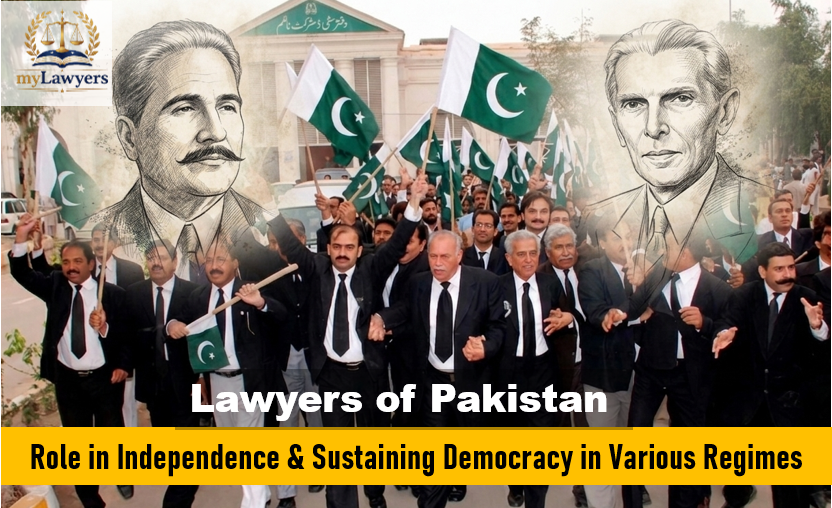
Lawyers of Pakistan have played a distinctive and often courageous role in country’s political and constitutional history. From the struggle for independence to the country’s encounters with military rule, constitutional crises and democratic transitions, the legal fraternity has repeatedly stood at the intersection of law, politics and civil liberties. While not every lawyer or bar association has always taken the same position, Pakistan’s history demonstrates that the legal profession has been one of the most important institutional voices for constitutionalism and democratic governance.
Struggle for Independence & Lawyers of Pakistan:
In 2026, when we are celebrating 80th year of independence, the political struggle that culminated in the creation of Pakistan was strongly influenced by lawyers cannot be ignored. Muhammad Ali Jinnah, himself a renowned barrister, demonstrated how constitutional law and political negotiation could be used as instruments of political transformation. His leadership of the All-India Muslim League relied heavily on constitutional arguments, legislative advocacy and legal reasoning. Allama Iqbal was another distinguished legal mind, who conceptualized Pakistan and exchanged a series of correspondences in letters with Muhammad Ali Jinnah pertaining to an independent Muslim state.
However, Jinnah’s approach was fundamentally constitutional. Rather than treating political rights merely as a matter of force, he pursued them through negotiations, legislative institutions, constitutional proposals and political representation. Other prominent Muslim lawyers also contributed to the movement for Pakistan, demonstrating the important role of the legal profession in articulating the political, constitutional and minority-rights questions surrounding the creation of the new state.
After independence in 1947, lawyers inherited an even greater responsibility: helping establish a constitutional order in a country facing enormous institutional and political challenges.
Defending Constitutionalism in the Early Years:
Pakistan’s early constitutional history was marked by political instability and institutional tensions. The dissolution of the Constituent Assembly in 1954 and subsequent constitutional disputes raised fundamental questions about the supremacy of law and the limits of executive authority.
The judiciary’s decision in Federation of Pakistan vs. Maulvi Tamizuddin Khan became an important episode in this history. Although the legal profession continued to debate the constitutional implications of the decision, it highlighted the central question that would repeatedly confront Pakistan: whether state institutions would operate according to constitutional limitations or political expediency.
The lawyers’ community gradually became an important forum for defending judicial independence and constitutional government. Bar associations and individual advocates provided platforms for debate at times when political institutions were weak or constrained.

Lawyers Under Military Rule:
The role of lawyers became particularly significant during periods of military rule. General Ayub Khan’s takeover in 1958, General Yahya Khan’s rule, General Zia-ul-Haq’s military government from 1977 and General Pervez Musharraf’s coup in 1999 each created different challenges for constitutional governance.
During these periods, lawyers were often required to navigate a difficult balance between professional duties, judicial proceedings and political restrictions. Some lawyers cooperated with governments, while others challenged authoritarian measures. This diversity is important because the history of the legal profession cannot simply be described as uniformly resistant to military governments. Nevertheless, at critical moments, lawyers emerged as some of the most visible defenders of constitutional rights.
Lawyers’ Movement of 2007:
The Lawyers’ Movement of 2007 remains the most prominent example. President Pervez Musharraf’s suspension of Chief Justice Iftikhar Muhammad Chaudhry triggered widespread protests by lawyers. What began as a dispute concerning judicial independence developed into a nationwide movement involving lawyers, civil society, political parties, journalists and citizens.
The movement challenged executive interference in the judiciary and ultimately contributed to the restoration of the deposed judges. More broadly, it demonstrated that an organised legal community could transform a professional dispute into a national constitutional movement.
Lawyers and Democratic Transitions:
Pakistan’s return to civilian democratic government has not eliminated constitutional challenges. Questions involving electoral legitimacy, parliamentary authority, fundamental rights, accountability and institutional jurisdiction continue to reach the courts.
In this environment, lawyers serve several functions. They represent citizens whose rights have allegedly been violated, challenge unlawful government actions, defend accused persons, interpret constitutional provisions and assist courts in resolving disputes between state institutions.
The bar is also an important democratic institution in its own right. Bar elections provide lawyers with experience in representation, campaigning, debate and collective decision-making. Bar associations frequently issue statements on constitutional questions and judicial independence, making them part of the broader civil-society ecosystem that sustains democratic discourse.

The Responsibility of the Modern Legal Fraternity:
Democracy is not simply the holding of elections. It also requires constitutional government, equality before law, freedom of expression, due process and access to justice. Lawyers therefore contribute to democracy every day through ordinary legal practice.
The history of lawyers in Pakistan also carries lessons for the future. The legal profession must remain independent not only from governments but also from political parties, commercial pressures and internal divisions. Lawyers cannot effectively defend constitutionalism if professional institutions themselves become vulnerable to political influence or violence.
Pakistan needs a legal fraternity committed to the principle that constitutional rights belong to everyone, regardless of political affiliation. The independence of the judiciary, freedom of the legal profession and access to justice must be defended consistently rather than selectively.
Digital transformation also presents new responsibilities. Cybercrime, artificial intelligence, digital evidence, data protection and online freedoms are creating legal questions that require a modern and technologically informed profession.
By
Editorial, myLawyers.pk
Frequently Asked Questions (FAQs)
1. What role did lawyers play in the creation of Pakistan?
Lawyers played a significant role in the political and constitutional struggle that led to the creation of Pakistan. Muhammad Ali Jinnah, a prominent barrister, used constitutional law, legislative advocacy and political negotiations to advance the demand for Muslim political rights. Allama Iqbal, also a distinguished legal mind, contributed intellectually to the idea of a separate Muslim state. Other Muslim lawyers also participated in political and constitutional debates surrounding the Pakistan Movement.
2. How did lawyers contribute to defending constitutionalism in Pakistan’s early years?
Following independence, lawyers became important participants in constitutional debates and challenges to executive authority. Events such as the dissolution of the Constituent Assembly in 1954 and the Federation of Pakistan v. Maulvi Tamizuddin Khan case raised fundamental questions about constitutional supremacy and the rule of law. However, lawyers and bar associations provided platforms for defending judicial independence and constitutional governance during periods of institutional uncertainty.
3. What was the role of lawyers during Pakistan’s military regimes?
During the military governments of Ayub Khan, Yahya Khan, Zia-ul-Haq and Pervez Musharraf, lawyers faced significant challenges concerning constitutional rights and judicial independence. While some members of the legal profession supported or worked within these regimes, others challenged authoritarian measures and defended constitutional principles. At important moments, lawyers became prominent voices for civil liberties, judicial independence and the restoration of constitutional rule.
4. Why was the Lawyers’ Movement of 2007 important for Pakistan’s democracy?
The Lawyers’ Movement began after President Pervez Musharraf suspended Chief Justice Iftikhar Muhammad Chaudhry. What initially concerned judicial independence developed into a nationwide movement involving lawyers, civil society, political parties, journalists and citizens. The movement became a major expression of resistance to executive interference in the judiciary and contributed to the restoration of deposed judges. It demonstrated the ability of an organised legal community to influence Pakistan’s constitutional and democratic development.
5. What is the responsibility of lawyers in sustaining Pakistan’s democracy today?
Modern lawyers have a responsibility to protect constitutional rights, judicial independence, due process and equality before the law, irrespective of political affiliation. They can strengthen democracy by challenging unlawful government actions, representing citizens, supporting access to justice and maintaining the independence of bar institutions. They must also adapt to emerging legal challenges involving artificial intelligence, cybercrime, digital evidence, data protection and online freedoms, ensuring that technological progress remains consistent with constitutional rights and the rule of law. Following independence, lawyers became important participants in constitutional debates and challenges to executive authority. Lawyers and bar associations provided platforms for defending judicial independence and constitutional governance during periods of institutional uncertainty.